Memories of sailing, boatbuilding and the people who made those days special, told from my own experience.
Keep the Sail Smiling
Memories of sailing in Crosshaven
“Keep the sail smiling.” That was the advice my granduncle gave me. For me, it meant something practical: don’t haul the sail in too tightly or let it out too far. Watch for that little flutter and find the trim that gives the boat its best pull. It became a small mantra I carried with me.
I was born into a sailing family. My father sailed, as did my uncles and their friends. My mother’s brother, Denis Doyle, became well known in sailing, competing in events such as the Fastnet and Round Ireland in his succession of boats named Moonduster.
My own sailing began in earnest in 1956, in Crosshaven, County Cork. Before I left Ireland for New Zealand, sailing filled much of my life. From Easter through October, I was out several days a week.
I sailed the 505, a dinghy just over five metres long. I thought of it as the Formula One of racing dinghies. There were two of us aboard: the skipper steered, while I handled the jib and spinnaker. On the trapeze, I hooked my harness to a wire from the mast and leaned out to help keep the boat level. At speed, it was fantastic. We could reach about sixteen knots, and the boat felt like a slate skimming across the water.
At a 505 World Championship in Cork Harbour, I sailed with Clayton Love as skipper. As I remember it, there were about ninety boats. After a week of racing, we finished seventh. That was very pleasing—very uplifting—and put us inside the top ten per cent of the fleet.
The start was usually the most exciting part. You wanted to reach the line just as the gun went, with the boat already moving. Too early and you were in trouble; hang back and you gave away an advantage. Get the timing right, and your momentum carried you through.
The day did not finish when we came ashore. There were wet clothes, a shower, a drink at the bar, and at weekends dinners with after-dinner speakers. When I was younger, I also found my way into the kitchen, where the staff preparing the roast beef would give me tasty cuttings. Those memories belong together: the racing, the cold and wet, the welcome ashore, the kitchen and the dining room.
And through it all, a few words from my granduncle stayed with me: “Keep the sail smiling.”
The Race We Missed Jim
Racing Doldrum at Mumbles
We won every race but one. The one we didn’t win was the day Jim stayed ashore.
There had been very little wind, and leaving one man behind seemed a sensible way to lighten the boat. Then the wind came up. With only two of us aboard, we missed his weight. A couple of boats passed us because their crews could hold their boats down better against the wind.
That is one of my clearest memories of racing at Mumbles, near Swansea, aboard Doldrum, Dick Lane’s eighteen-footer. There were three of us: Dick, Jim Denver and me. After sailing the 505, which I thought of as the Formula One of racing dinghies, I spent some very enjoyable years in a National 18. It was a more conservative boat: no trapeze, just our feet hooked under straps as we leaned out over the side. The combined weight of three people helped keep the boat level when the wind pressed against the sails.
We travelled over for the event I remember as the Cock of the North. Dick, Jim and I were the only Irish crew there, as I recall. It was a very successful visit. We won every race except the one when Jim stayed ashore. I cannot now remember whether the regatta lasted five days or seven, but I remember the racing and the satisfaction of doing well.
There was team racing during the visit too, with three boats making up a team. I sailed one boat, Dick another, and an Irish dredger captain who worked around Swansea Bay and the Bristol Channel sailed the third. We nearly won that as well, and we brought home some good trophies.
Looking back, it was a week with plenty to enjoy: travelling over from Ireland, racing against the other crews, and bringing trophies home. But the race we lost has stayed particularly clear in my memory. We had left Jim ashore to make the boat lighter. By later in the day, we would have been glad to have him back aboard.
A Sunday on Cork Harbour with the Veteran Fisherman
A boyhood adventure with oars, fishing lines and a sail home
When I was about eight or nine, I sometimes went out in a boat with the Veteran Fisherman. I knew him because his sister worked in our house, and I would stay with him. He owned the boat and was often joined by friends, including the postmaster and a few other pipe-smoking companions.
We hauled the boat down the strand and into the river, set up the oars, and rowed through East Ferry and out into Cork Harbour. On the way, we stopped at East Ferry. There was a well in the woods, and I would carry a billy can up to fill with water. The men made a fire so we could boil it for tea. We ate sandwiches and meat before setting off again.
The Veteran Fisherman had a remarkable way with fish. He taught me how to catch them with my hands. Although he was half blind, he would sometimes go into the river in his clothes, carrying a net, and bring fish out with him.
We rowed past the old forts at the harbour entrance and Roche’s Point lighthouse. The forts were long past their working days, but their buildings and earthworks were still visible on both sides of the entrance. To find our fishing spot, the men used cross bearings from a road and a cathedral.
We fished with lines called “feathers”, weighted at the bottom and covered with colourful feathered hooks. We worked them up and down until we felt a tug. Sometimes four or five mackerel came aboard at once. We unhooked them one by one and dropped them into a bucket.
When the fishing was over, we raised a square sail on a mast at the front of the boat and steered with a tiller at the back. The southwesterly wind carried us home across the harbour and up the river. On the way, we stopped at Murph’s pub. The men went in for a couple of stouts—Murphy’s, Beamish or Guinness—then we climbed aboard again.
At the end of the day, we hauled the boat onto the strand and tied it to a tree until the next Sunday. I remember the whole adventure: the oars, well water and hot tea, the flash of mackerel on the lines, and the sail home with the Veteran Fisherman and his friends.
Sopranino: A Solo Built in a Cork Wine Warehouse
Building a boat by hand, then sailing southwest Ireland
Our boatyard was a wine warehouse in Cork’s docklands. It was an unusual place to build a sailing dinghy, but five others and I each set out to build a Solo of our own. A veteran boatbuilder from the Cork and West Cork tradition brought his skill to the project.
The Solo was designed for one sailor. The Enterprise, which was more familiar around the UK at the time, usually carried two: one handling the jib forward and the other steering and managing the mainsail.
We built the frames from mahogany and the hulls from marine plywood. The mast and boom were spruce. With the boatbuilder’s help, I set up the frames, cut and joined the plywood, and shaped the timber. I especially enjoyed working with the planes, cutting and forming the wood by hand.
The mast and boom were hollowed out and shaped before being glued together. I remember using Cascamite, a glue that held the timber firmly and was manageable to work with. Bit by bit, the boat took shape. I remember naming mine Sopranino, after a little wind instrument, though I can’t be certain I have the name exactly right.
Building her was only part of the pleasure. I later sailed Sopranino in Cork Harbour, Bantry Bay and around Schull, near Baltimore in southwest Ireland. She gave me the chance to explore beautiful waters in a boat I had helped make with my own hands. Whenever I sailed her, I knew I was taking a little piece of that Cork wine warehouse with me.
Four Brothers, One Boat: Returning to Cork
A family voyage aboard Kevin’s Sigma 38
For the first time in quite a while, the four of us brothers were together again. My brother Kevin had a boat called State O’ Chassis, a Sigma 38. Kevin, Dennis, David and I sailed her south from Dun Laoghaire to Cork.
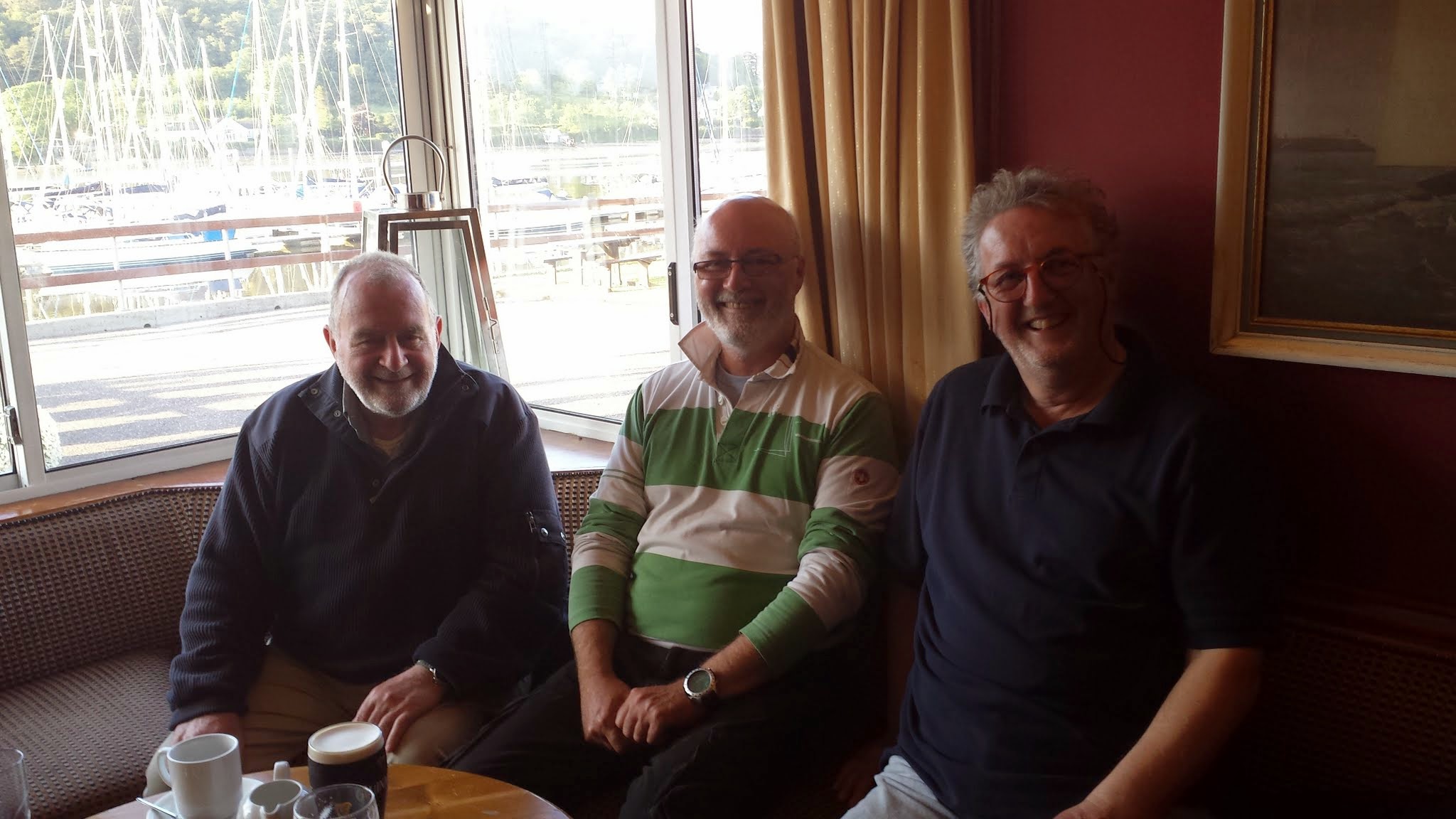
The three living brothers together beside the marina, in a photograph from 2013.
I had spent time overseas, as had Dennis and David, so the voyage gave us a chance to catch up and be together again. We were not just making a passage down the coast; we were sharing a trip that brought the family back together.
We sailed south along the east coast, around the south of Ireland and west towards Cork Harbour. I have a hazy memory of a stop along the way, but I’m not certain whether it was Rosslare or Dunmore East, so I’ll leave that detail open.
We sailed into Crosshaven, where I had spent ten years sailing—from 1956 to 1966—before leaving Ireland. We went to the yacht club where I had first started sailing as a young man. Coming back there with my brothers after all those years away made the trip feel wonderfully nostalgic. The place held so many memories of my early sailing life, and now I was seeing it again with the people I had grown up with.
I still have photographs from that voyage. They remind me of the coast, Kevin’s boat and, above all, the four of us sharing time together. State O’ Chassis carried us from Dublin to Cork and brought us back to a place that had been part of my life from the beginning.
Looking at this photograph now, I’m grateful for the time we shared. Three of us are still here, and we remember our brother with great affection.